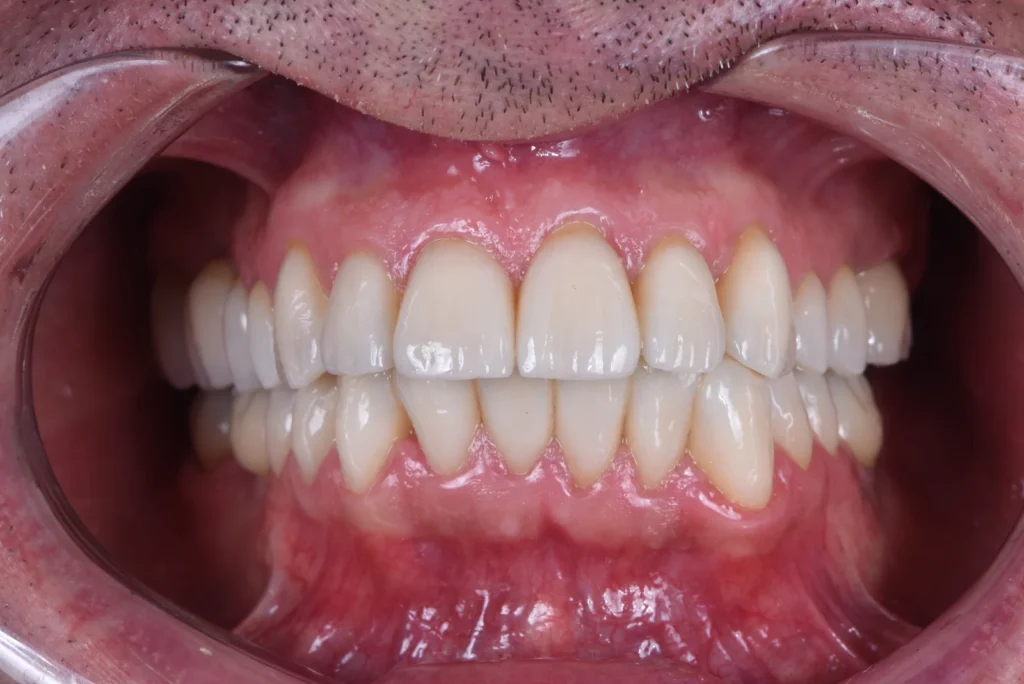
Full Mouth Rehabilitation Eindhoven: a bite that has worn down over the years, fillings that no longer seal, a smile that doesn’t feel like yours anymore. A full mouth rehabilitation brings everything back into a coherent treatment plan: bite, function and aesthetics together. In this article we walk through a real case from our practice in Eindhoven, including the before and after photos, and explain exactly how we work.
At VLIJT Tandartsen in the Strijp-S health centre, we work minimally invasively. That means: only what is worn, damaged or clinically necessary is treated. Everything healthy stays put. This principle is especially important in a complete rehabilitation, where you need to think about the whole system, not one tooth at a time, but all 28 teeth together.

What is a full mouth rehabilitation?
A full mouth rehabilitation is a complete renovation of the dentition where we restore bite, function and aesthetics together. Instead of addressing single teeth one at a time, we look at the dentition as one whole. What does each tooth need to work well together again?
A complete treatment like this usually only comes into play when several issues are happening at once:
- Wear that has lowered the bite height
- Old fillings with poor margins or hairline cracks
- Different materials or colours throughout the mouth
- Loss of function. Chewing takes more effort
- Aesthetic dissatisfaction (colour, shape or position of teeth)
The solution is not “demolish everything and replace”. It is targeted restoration with preservation of as much natural tooth tissue as possible. We use crowns, veneers and sometimes inlays for this. Which one depends on what each tooth actually needs.
The starting situation
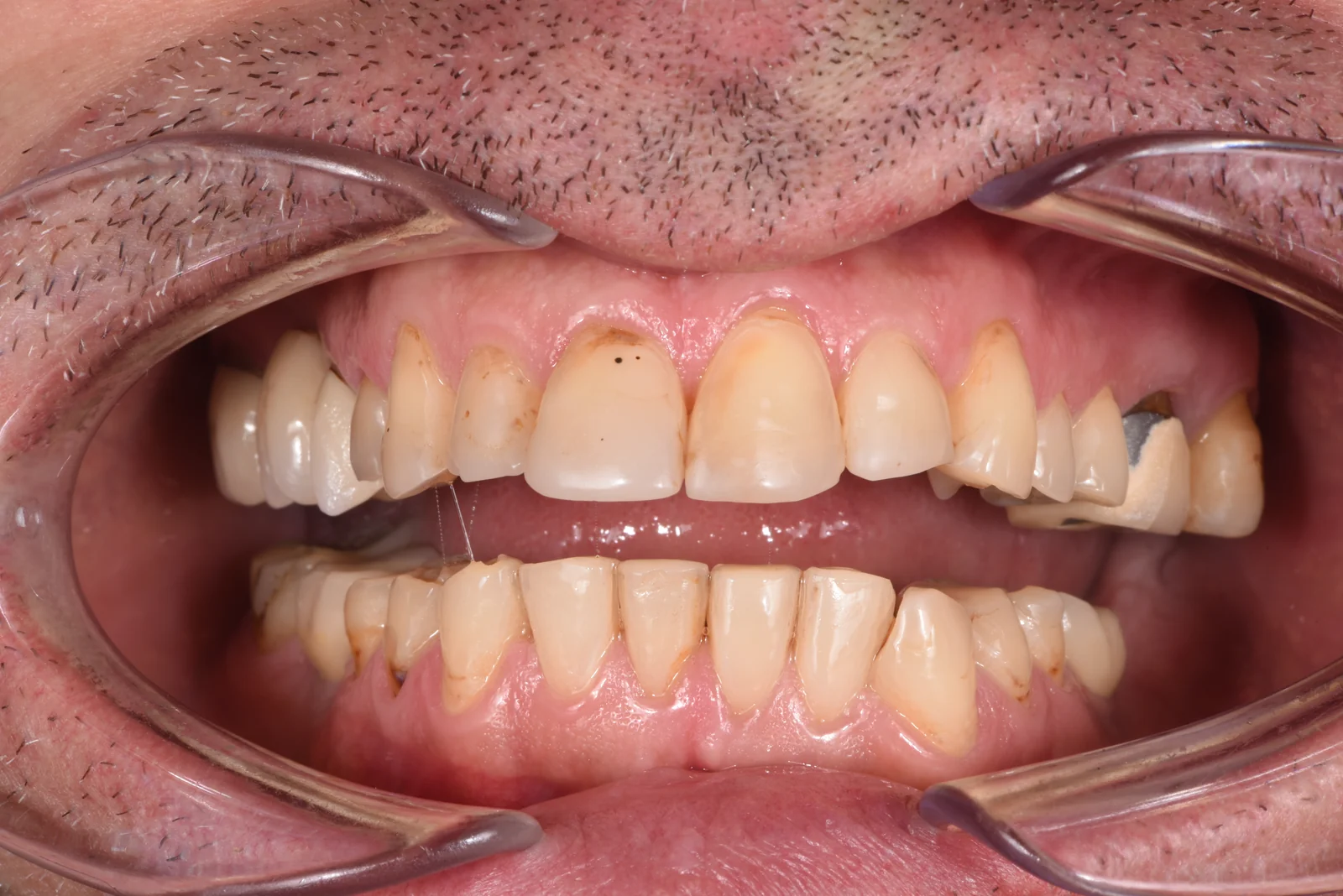
Our patient was a man with an active life and high standards for his smile. He came to us with a clear request. He wasn’t happy with how his front teeth looked: too dark, not pleasing in shape, and his smile no longer felt right for who he is.
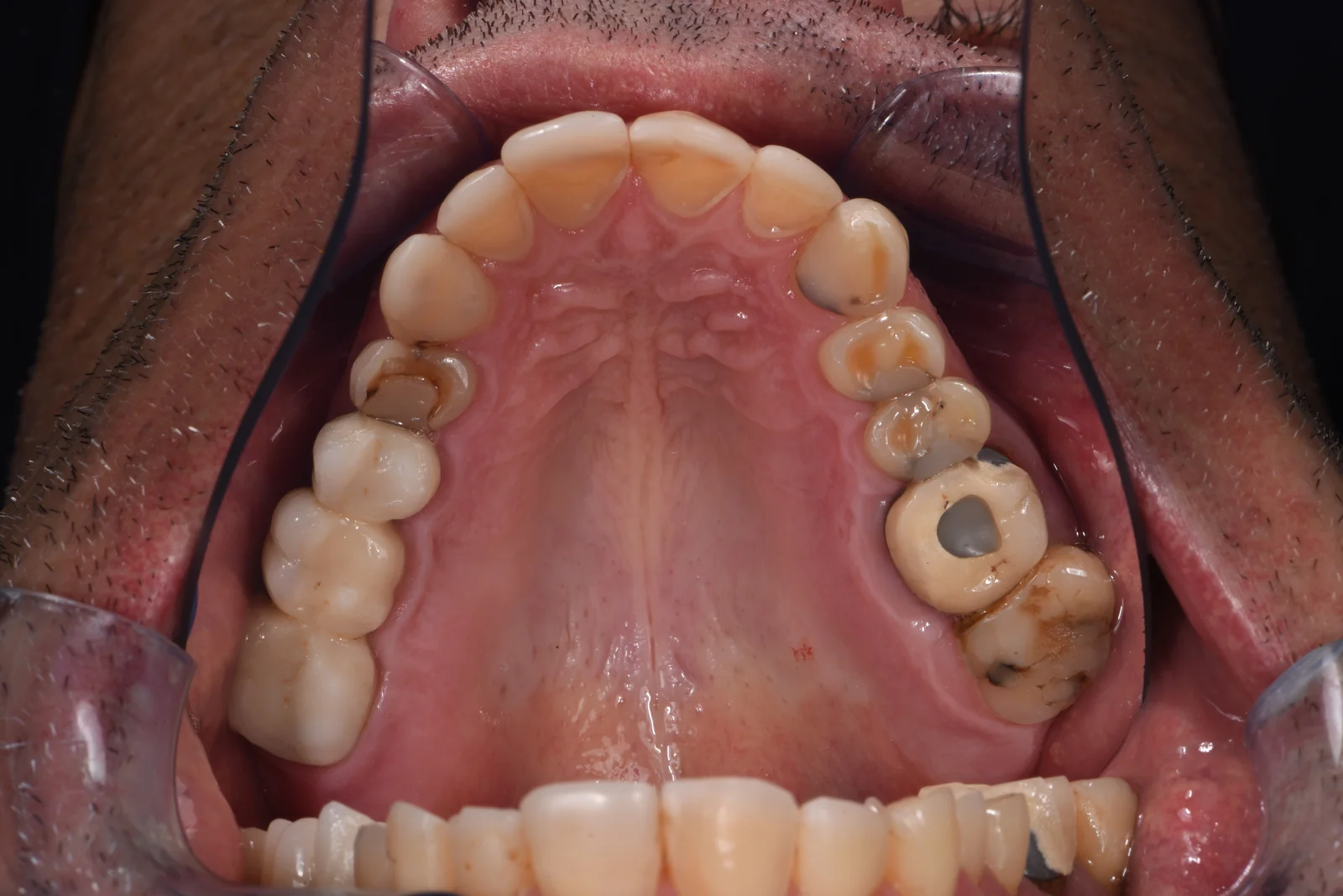
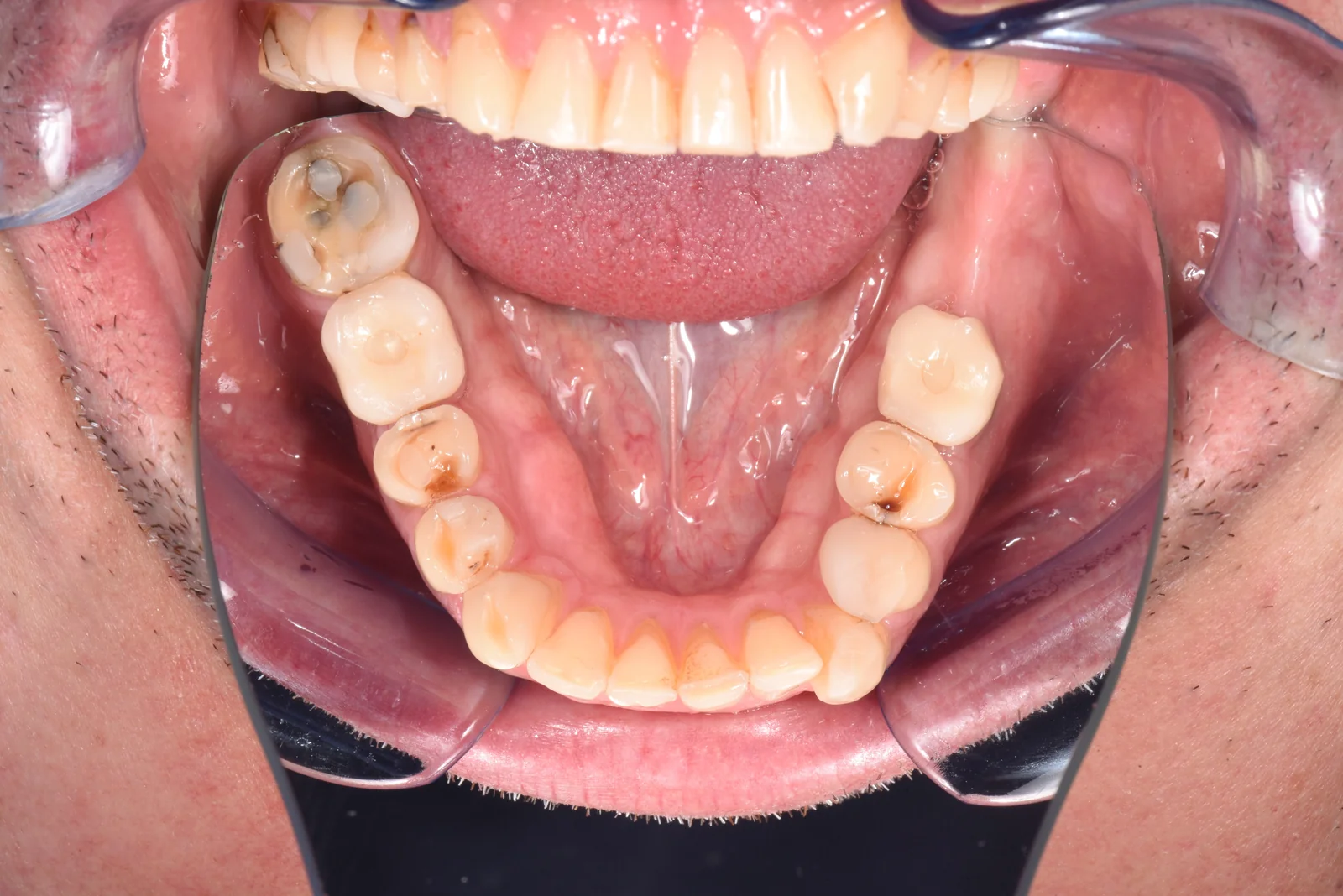
What we saw clinically at intake:
- Poor margins on fillings across several teeth
- Insufficient oral hygiene. Plaque and tartar between restorations
- Loss of bite height from wear. Upper and lower jaw were no longer in the correct relationship
- Misalignment of some teeth due to lack of space
- Suboptimal function. Less efficient chewing
- Mixed materials and colours built up over the years: composite, amalgam, older porcelain, all in one mouth
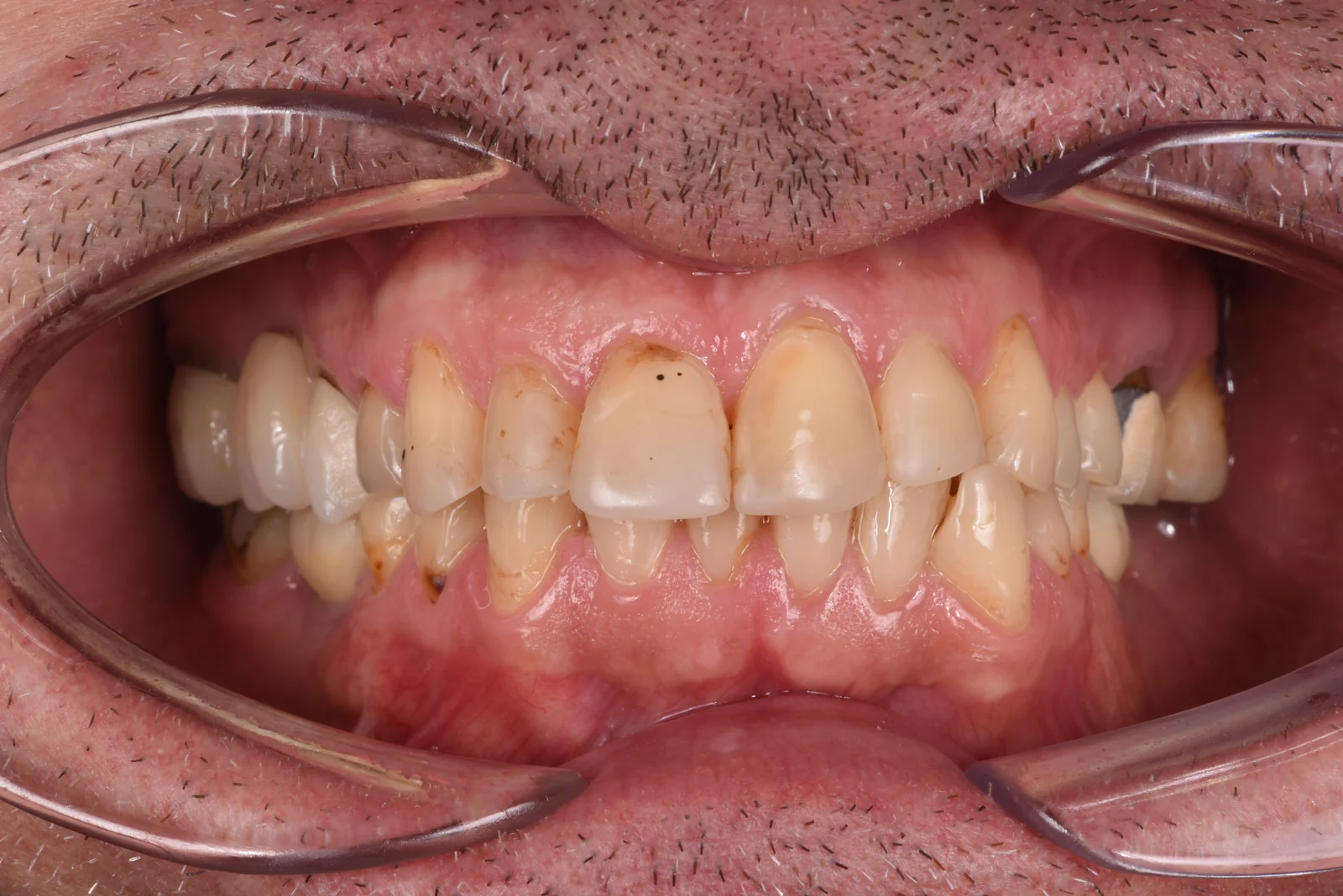
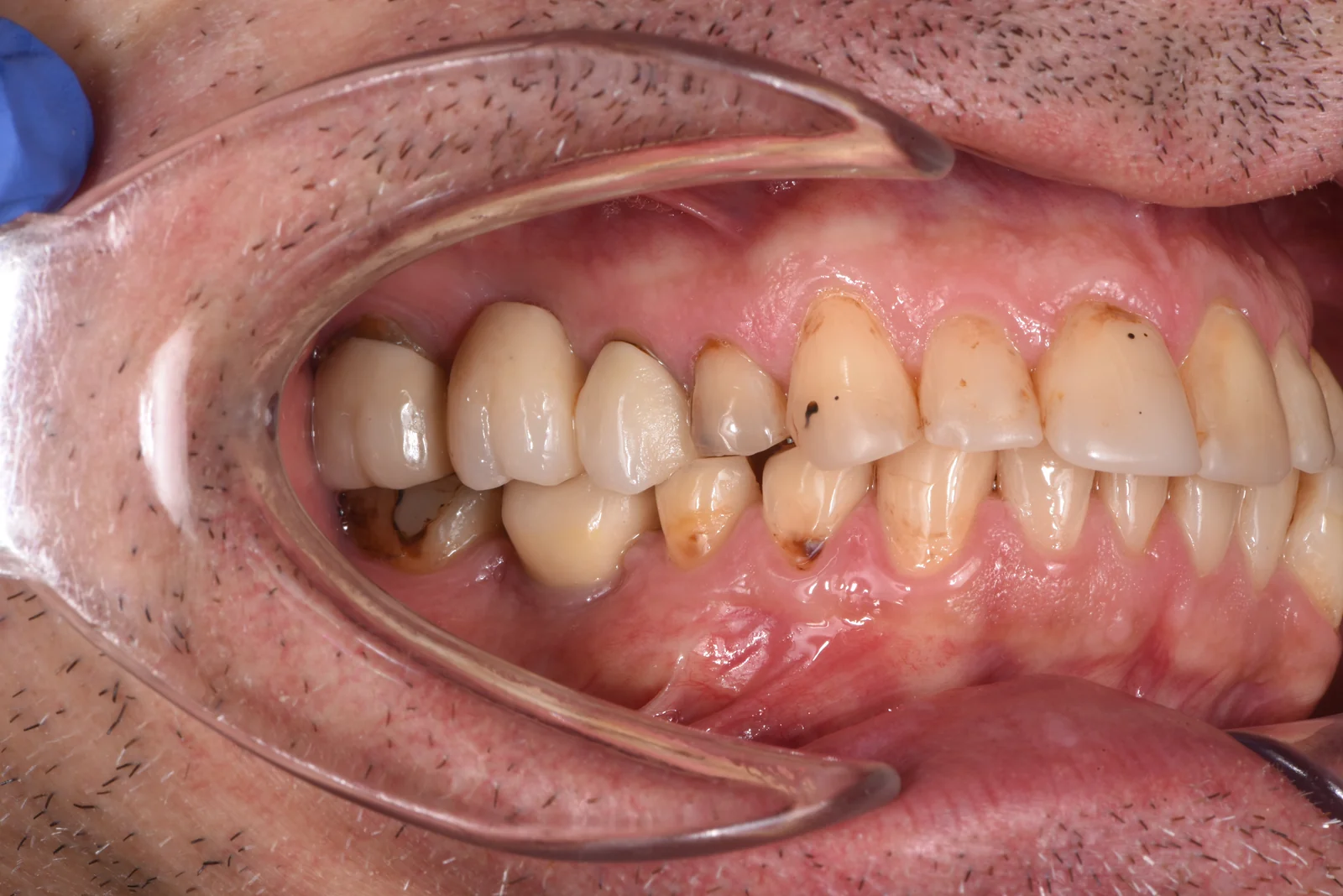
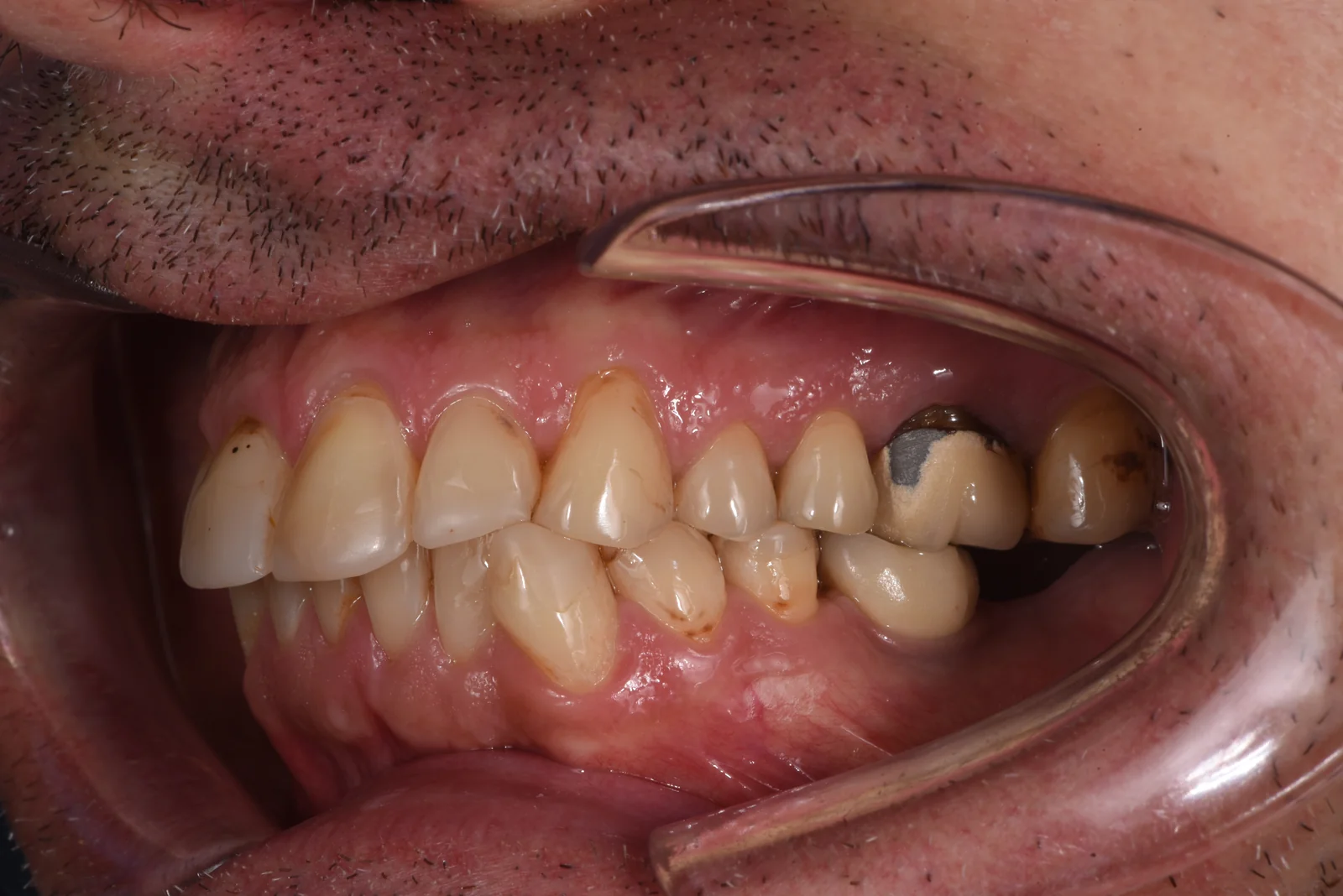
Important pre-condition: the patient absolutely did not want braces. He wanted his smile back within a reasonable time frame. Not 18 to 24 months of brackets, retainers and regular adjustment sessions. That preference is completely legitimate and shapes which route you choose.
How we approach this kind of request
Before we make a treatment plan, we go through six steps with the patient. No standard package, no “this fits in a week” promise.
- Map the request properly. What exactly do you want? Aesthetics, function, or both? Short term or decades?
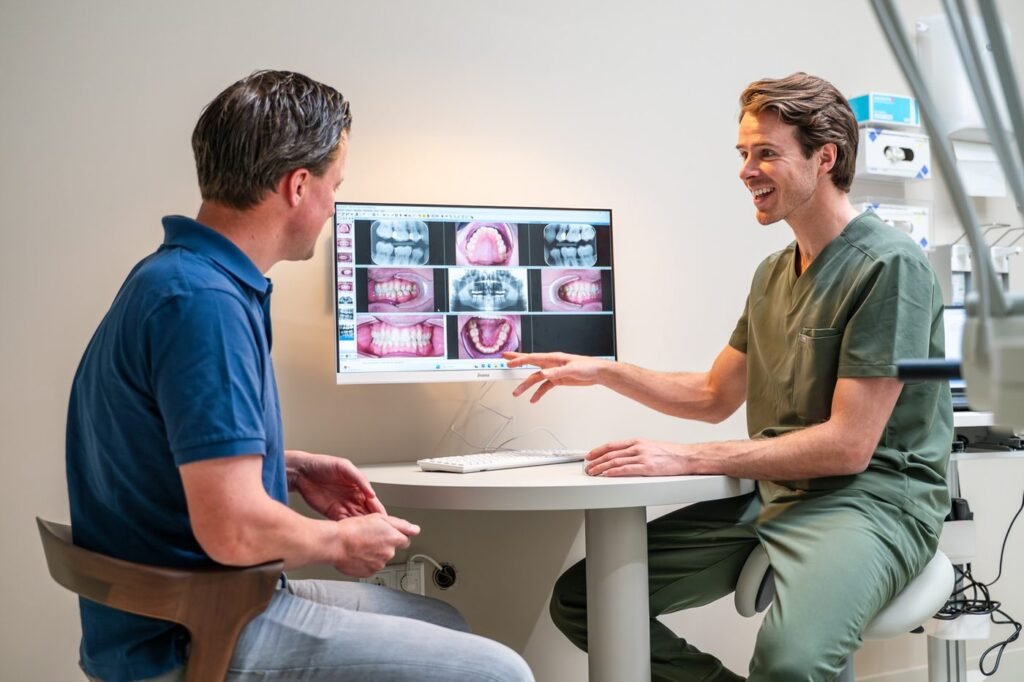
- Awareness through photographs. We take close-ups and show what is actually going on. Many people are surprised, not because the situation is dramatic, but because they have never seen it like this.
- Improve oral hygiene first. Before we place anything durable, the foundation has to be right. Our dental hygienist or prevention assistant guides this step (often 2 sessions, sometimes more).
- Discuss treatment options. Braces, partial approach, or complete rehabilitation. With the pros and cons of each route.
- Try-in phase. Before we replace even one tooth, you get to test the future result in your mouth.
- Fit the final work. Only after both parties are satisfied with the trial setup.
After weighing the options together with this patient, one route emerged: include the entire dentition in the plan, so we improve the bite and function in the same treatment.
Waxup and try-in: try first, then commit
A full mouth rehabilitation without a trial round is a gamble. That is why we work with a waxup: a model where our dental technician builds the new situation in wax first, exactly as it should appear in the mouth later.
You get to test that wax model in a try-in phase. We place it temporarily in your mouth. You live with it for a moment, you chew on it, you check it in the mirror, you show it to your partner or a friend. Does the shape work? Is the colour right? Does the bite feel natural?
Only when you genuinely say yes do we move on to the final work. No “we’ll see how it turns out” moments. No surprises afterwards.
The treatment: upper jaw first, then lower jaw
We do not perform a full mouth rehabilitation in one long session. We split it into phases and work one jaw at a time: first finish the upper jaw, then the lower jaw. That way you always have one well-functioning jaw to chew with throughout the process.
For each tooth or molar we go through these steps:
- Remove old fillings. Everything worn or no longer bonded comes out.
- Check the base. What is still healthy natural tooth tissue? That stays. This is the minimally invasive approach in practice.
- Build a foundation. A new base that can support the future crown or veneer.
- Take impressions of the crown or veneer. A physical impression or a digital scan.
- Place the final work. The shape, colour and position previously approved via the waxup.
For this patient, we started with the upper jaw: veneers on the front teeth, crowns on the molars. The lower jaw followed the same approach. At the end of the journey the upper and lower jaw were back in the correct relationship. The bite height was restored and the appearance matched his request.
The result: before and after
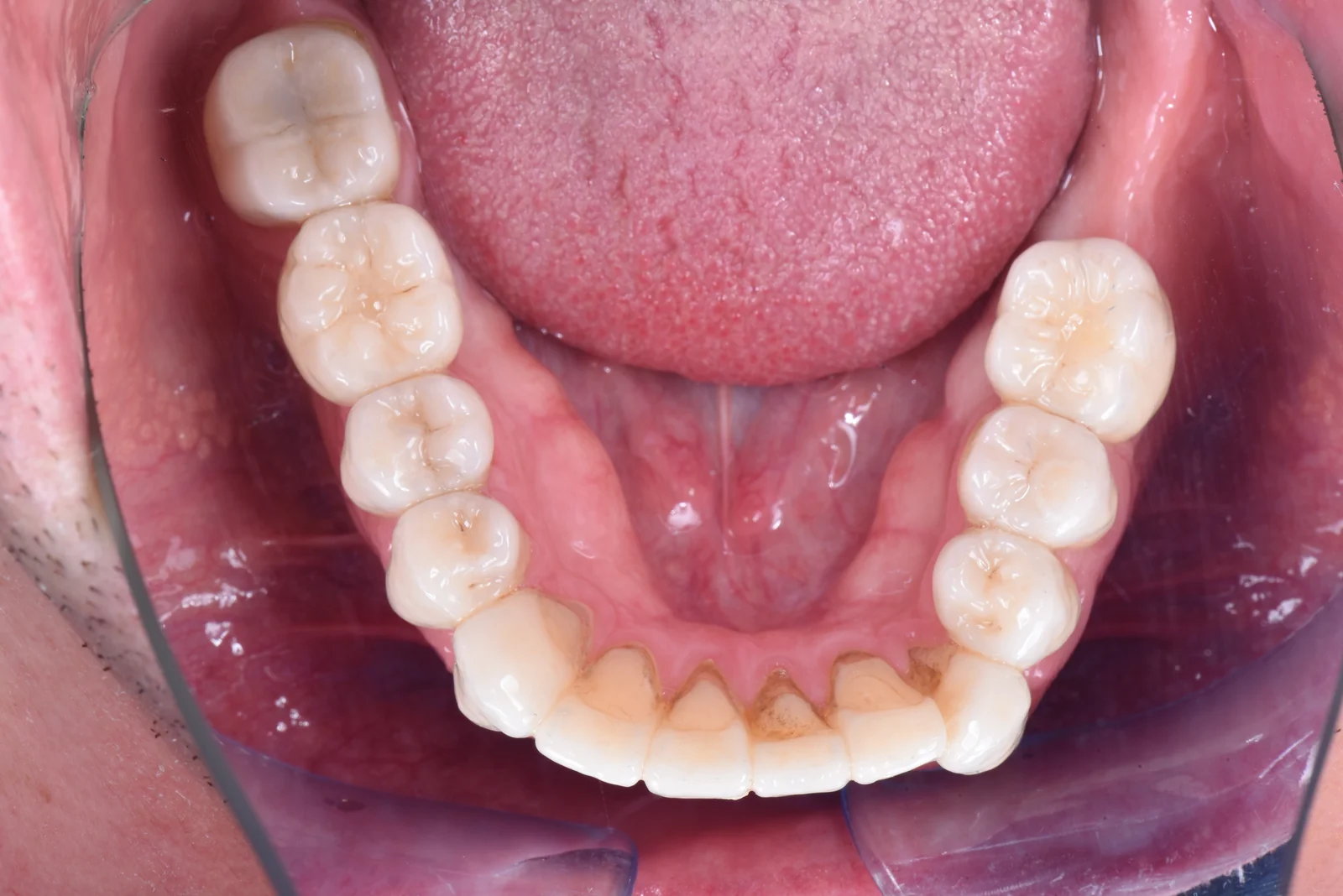
Below the after situation, alongside what was achieved compared to the start:
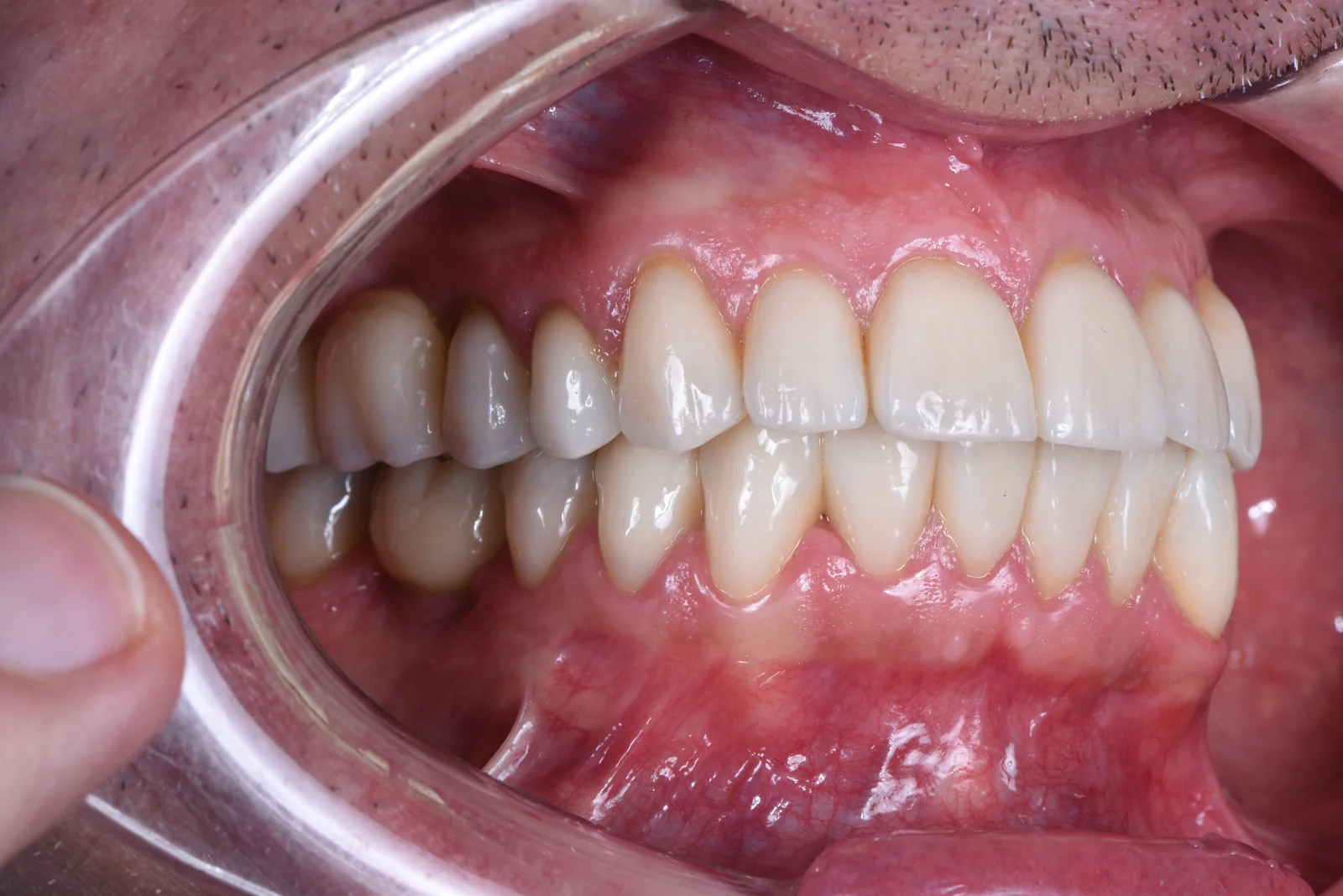
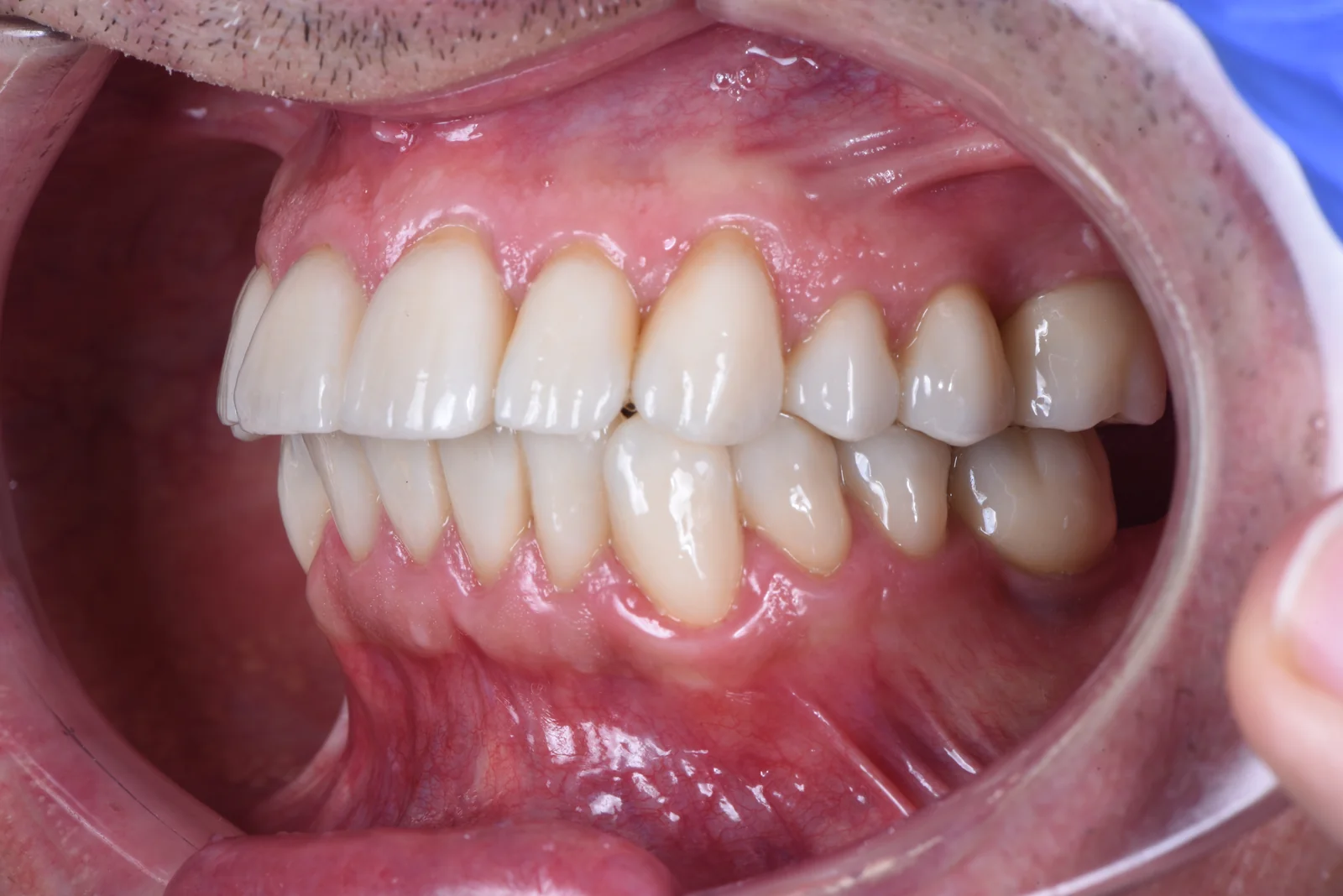
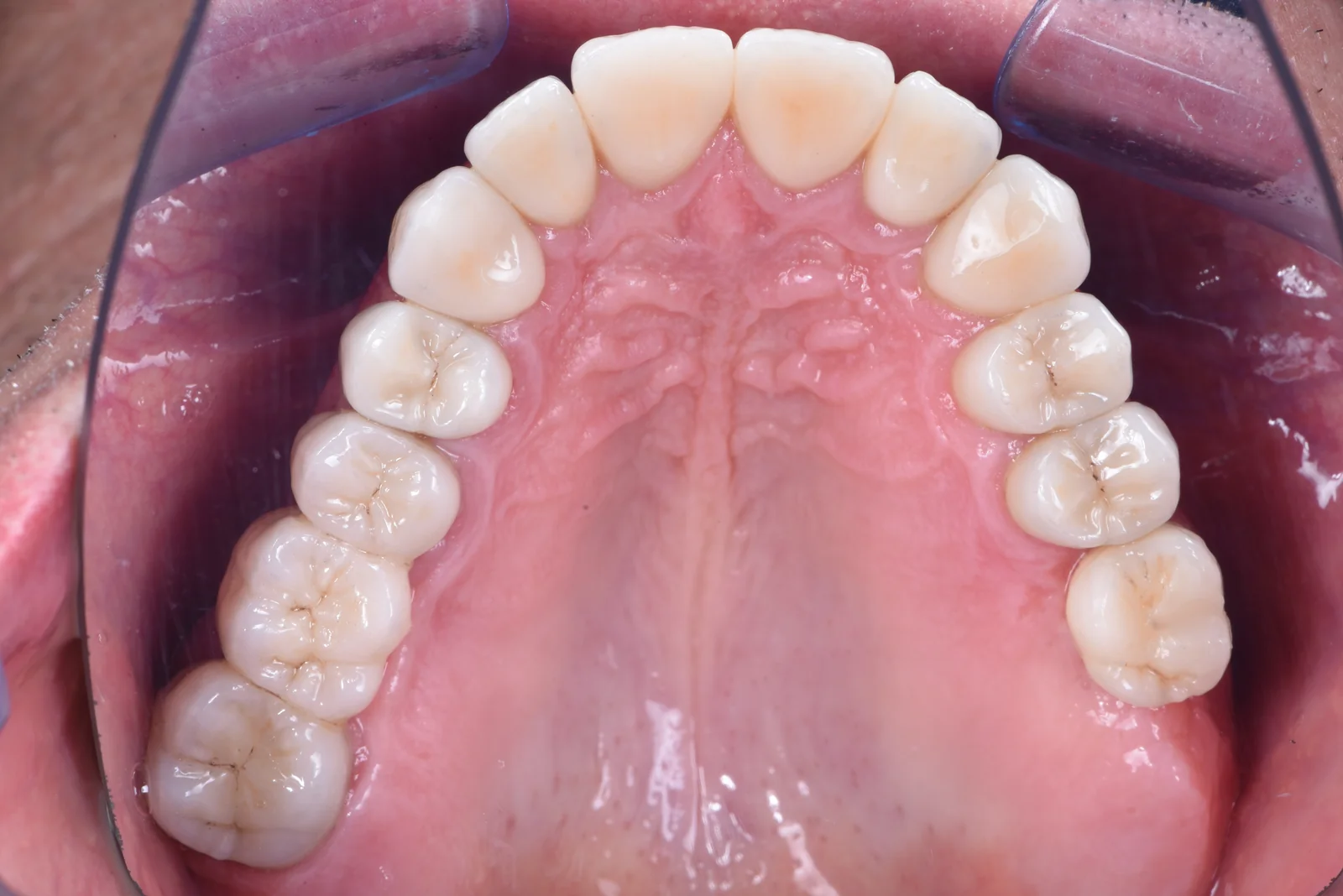
What you can see:
- Uniform colour. All teeth back in line in terms of tone, without the “patchwork” appearance of earlier fillings.
- Restored bite height. The proper relationship between upper and lower jaw is back, which also gives the lower face a slightly firmer shape.
- Natural form. No “TV smile”, no overly white teeth. Just a smile that suits his age and personality.
- Better function. Chewing is efficient again. No overloading of specific teeth.
Why this did not become an orthodontic case
This is a question we hear often from people with misalignment or bite issues: “Why not braces?” The short answer: because the patient didn’t want braces, and because we could achieve an excellent bite with veneers and crowns too.
The choice between orthodontics (braces) and restorative rehabilitation depends on:
- What is the underlying cause? Misalignment from tooth loss and wear? Often solvable restoratively. Misalignment from deep skeletal growth from a young age? Orthodontics usually fits better.
- Patient preference. Braces are a 12 to 24 month investment. Not everyone wants or can commit to that.
- Clinical feasibility. Sometimes the restorative route is simply the cleaner solution, and braces would be an unnecessarily invasive way to reach the same endpoint.
For this patient all three factors aligned with “restorative rehabilitation”. That is why we chose this route. For someone else it might well have been a braces case. No standard answer. Always individual.
What makes our approach in Eindhoven different?
There are more practices that offer full mouth rehabilitation. What do we do deliberately differently at VLIJT?
One: no pressure to start. A full mouth rehabilitation is a major decision. We present the options, give you a written overview, and only schedule follow-up appointments when you are ready. Some patients wait a few weeks, some wait months. That is fine.
Two: minimally invasive as a starting point. Healthy natural tooth tissue stays. A tooth that is 70% intact does not get a full crown “because it would look more symmetrical”. That is a waste of what you have.
Three: try-in before the real work. No “we’ll see how it turns out afterwards”. First test, then decide.
Four: collaboration with the dental hygienist. A rehabilitation without a clean starting situation is an expensive restoration on a weak foundation. We work with the dental hygienist or prevention assistant as an equal partner in the process. At extra cost? No. Preparation is part of the plan.
Five: a modern centre on Strijp-S. Health centre Strijp-S Eindhoven with digital scans, 3D imaging and modern treatment rooms. Up to date equipment, no compromises.
Frequently asked questions about full mouth rehabilitation
How many appointments does a complete full mouth rehabilitation take? On average 6 to 10 appointments spread over 3 to 6 months, depending on the number of teeth and the complexity. We plan them around your schedule, typically 2-3 weeks between sessions.
Does it hurt? During the treatment we work under local anaesthesia, so you feel nothing. After each session there is usually 1-3 days of mild sensitivity, comparable to a regular filling. For larger procedures we may give you paracetamol guidance.
How long does the work last? With good self-care and regular check-ups, crowns and veneers last on average 10 to 15 years, often longer. Your natural underlying tooth typically stays preserved, so the solution can be renewed when needed.
Do I need braces before the rehabilitation? That depends on the underlying cause of any misalignment. For some patients a short orthodontic pre-treatment is better. For others we solve it restoratively. We discuss this honestly during the intake conversation.
Is a full mouth rehabilitation covered by my insurance? Restorative work largely falls under supplementary dental insurance. We help you with a cost estimate so you know upfront what your insurance will contribute. We do not make assumptions about your policy. We provide a quote you can calmly check with your insurer.
Can I keep my front teeth during the treatment? Almost always yes. We work minimally invasively. Healthy tissue stays. Only the outer surface or worn edges are prepared so the new veneer or crown fits properly.
What if I want to stop halfway? You always can. We work in phases (upper and lower jaw separately), so each phase stands on its own. You are not locked into an “all or nothing” contract.
Looking for a dentist for full mouth rehabilitation in Eindhoven?
If your smile no longer feels like yours, or if chewing and biting take more effort than they used to, those are signals that a conversation with a dentist makes sense. Not necessarily to schedule a complete rehabilitation right away, but to map out what is actually going on and which options fit your situation.
At VLIJT Tandartsen in Eindhoven (Strijp-S health centre) we plan an in-depth intake conversation where we look together at what you want and what is clinically needed. No pressure to decide today.
👉 Book an intake at VLIJT Tandartsen. We will be in touch within 1 business day.
More on the treatments that can be part of a full mouth rehabilitation: