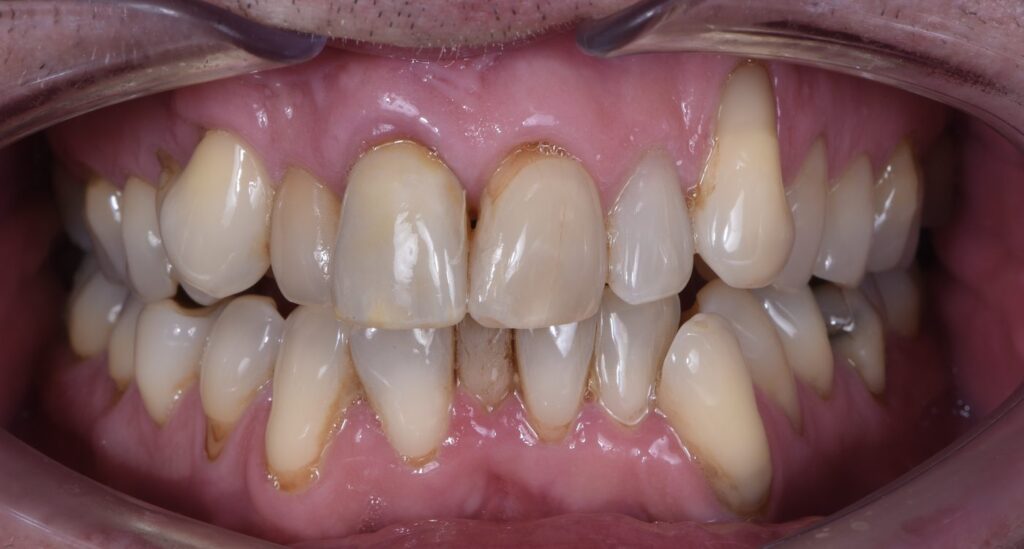
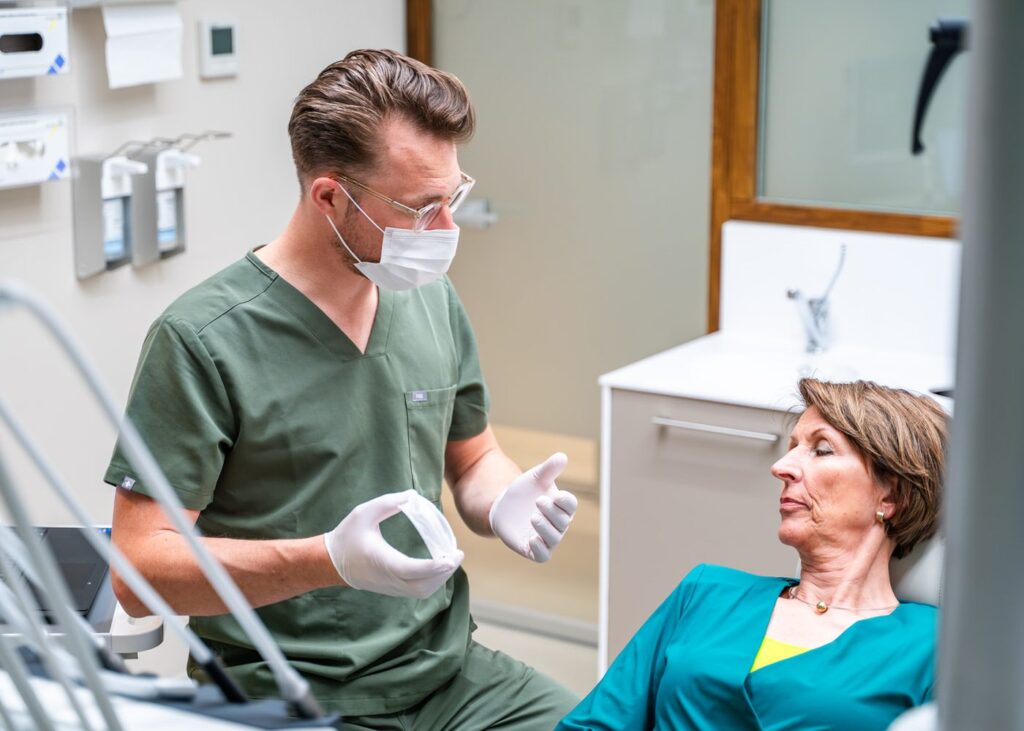
There is a moment when it becomes clear that patching up no longer works. Another crown, another root canal treatment, another molar giving up. At a certain point the question is no longer how to save this tooth, but what to do with the whole.
That is a heavy conversation. For many people a denture feels like a line being crossed. Yet afterwards we hear the same thing surprisingly often: I wish I had done this sooner.
Three forms, three very different experiences
The full denture
The classic denture. An acrylic plate with teeth that rests on the gum and holds by suction.
It works, it is the cheapest option and it can be made quickly. But the grip comes from suction, and that decreases as the jawbone recedes. That receding continues for as long as there are no roots in the bone.
Hence the adhesive paste that many people start using at some point.
The denture on implants, the click denture
Two to four implants in the jaw, which the denture clicks onto. You still take it out to clean it, but while you are wearing it, it stays put.
For most people this is the difference between tolerating a denture and forgetting about it. No adhesive paste, no shifting while eating, no worry that something will come loose when you laugh hard. And because the implants keep stimulating the jawbone, the bone deteriorates more slowly.
It costs more and it involves an implant procedure. For the lower jaw, where an ordinary denture holds worst, it is often worth the investment.
The partial denture
If there are healthy teeth left, not everything has to go. A partial denture fills the gaps and clasps onto what is still there.
The condition is that the remaining teeth are strong enough to carry it. We assess that per situation, because a denture resting on unstable teeth speeds up their loss.
How long does it take to get used to?
Honestly: longer than most people expect, and shorter than they fear.
The first days it feels big and full in the mouth. Speaking is different and there is more saliva. That is normal.
The first weeks your mouth learns to handle it. Start with soft food and small bites, and chew on both sides at once rather than on one side.
After a month or two most people no longer think about it. With a click denture that happens faster, because the grip is there straight away.
What helps: reading out loud in the first week. It sounds odd, but your tongue learns quickly from it.
And small pressure spots are perfectly normal at the start. Come back for those and we will adjust them. There is no need to walk around with a sore spot.
What does it cost and what is reimbursed?
Here the reimbursement is more favourable than for most dental care in the Netherlands.
A full denture is largely covered by the basic health insurance (basisverzekering), with a personal contribution. That is different from crowns or implants for single teeth, which fall outside the basic package.
For a denture on implants there is often also cover from the basic package, with a personal contribution that differs per jaw.
A partial denture usually falls under supplementary insurance.
The exact amounts and personal contributions change each year. We draw up a quote in advance so you know what you pay yourself before you start. Check your policy as well, because supplementary cover differs a lot per insurer.
How do you look after it?
A denture cannot get a cavity, but it can get dirty, and the gum underneath can become inflamed.
- Clean it every day, outside the mouth, with a denture brush and soap or a special cleaner. Not ordinary toothpaste, that is too abrasive
- Out at night, unless your dentist advises otherwise. Your gums need rest
- Keep it in water when it is out, otherwise the material can dry out
- Keep coming for check-ups. Even without your own teeth. We look at the gums, the fit and the jawbone
That last one is the most underestimated. A denture that no longer fits starts to rub, and you often only notice that once there is already damage.
What to expect at VLIJT in Eindhoven
We are based at Strijp-S and guide the whole process, from the first conversation to the aftercare.
- First working out which form suits you. Sometimes that is not the form you came in with
- A quote in advance, including what the insurance covers and what it does not
- Room for the conversation around it. This is about more than technique, and we know that
- Aftercare without fuss. Pressure spot? Come by, that is what it is for
- We speak English. Many of our patients moved to Eindhoven for work or study, and the quote, the fitting and the aftercare can all be handled in English
Frequently asked questions
What is the difference between a denture and a click denture?
A denture rests on the gum and holds by suction. A click denture clicks onto implants in the jaw and therefore stays in place while eating and speaking.
How long does it take to get used to a denture?
The first weeks feel strange, and after a month or two most people no longer think about it. With a click denture that goes faster.
Is a denture covered by insurance in the Netherlands?
A full denture is largely covered by the basic health insurance, with a personal contribution. For a partial denture you usually need supplementary insurance.
Should I take my denture out at night?
In principle yes. Your gums need rest. Keep it in water so the material does not dry out.
Do I still need check-ups without my own teeth?
Yes. We check the gums, the fit and the jawbone. A denture that no longer fits starts rubbing before you notice it yourself.
Can I eat everything with a denture?
Almost everything, after a settling-in period. Very hard or very sticky food stays trickier with an ordinary denture. With a click denture that is much less of a problem.
In closing
The question is rarely whether a denture is possible, but which form suits your jaw, your wishes and your budget. That difference is large, and it is worth talking it through properly before anything is made.
Want to know more? Read about dentures at VLIJT, see what implant-supported dentures add, or sign up for a conversation.