Implant after trauma: your path to a restored, natural smile
An accident happens faster than you think. Losing a tooth due to trauma is not only visible, it can also cause pain, loss of function, and lasting complaints. Fortunately, there are durable treatments that can restore both your appearance and your chewing function. A dental implant is one of the most reliable and proven solutions.
What is a dental implant? The foundation of a new tooth
What exactly do we mean by an implant? An implant is an artificial root — usually made from biocompatible titanium or zirconium — that is surgically placed in the jawbone. It forms a sturdy foundation for a crown, a bridge, or as support for a (partial) denture. It works like a natural tooth root and gives your new tooth stability, so you can smile, eat, and talk without worry again.
The challenge: a broken tooth after trauma and persistent complaints
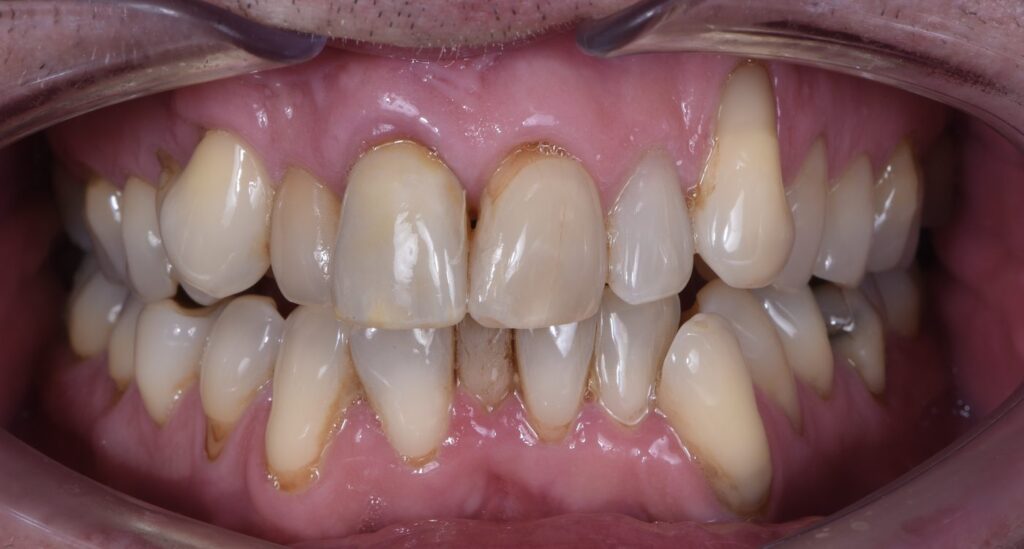
Imagine: you are in your early thirties and lose a tooth after a fall or impact. This situation happened to one of our patients. For months, he continued to experience pain and discomfort. After a second opinion at our practice, it became clear that the root of the tooth was completely fractured — the tooth could no longer be saved. These types of problems not only cause physical complaints but can also lead to insecurity and daily limitations. The patient wanted a definitive, reliable solution.
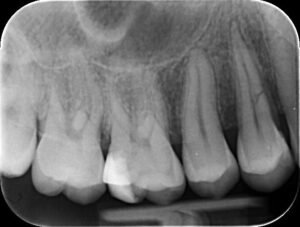
The solution: why an implant is often the most durable choice
For missing teeth, there are several options: an implant, a bridge, a frame denture, or a plate. For our young patient — and in many similar cases — we often recommend the most durable and natural choice: the dental implant. Why do we prefer this?
- Preservation of healthy teeth: Unlike a bridge, the adjacent healthy teeth do not need to be ground down. Your own teeth remain intact and unnecessary weakening is prevented.
- Fixed and comfortable: An implant is fixed in your mouth, just like a natural tooth. You do not need to remove or insert anything, which increases comfort and ease of speech compared to a frame or plate.
- Prevents bone loss: An implant stimulates the jawbone at the location of the missing tooth, reducing bone loss. This helps preserve the natural facial contour.
- Durability: Implants are a proven long-term solution. With good care, they can last for decades — an investment in your oral health for the future.
The treatment process: step by step towards a new smile
Placing an implant is a careful, phased process — especially in a complex situation like our patient with inflammation and bone loss. Below, we describe the usual steps we follow.
Step 1: Extraction and recovery
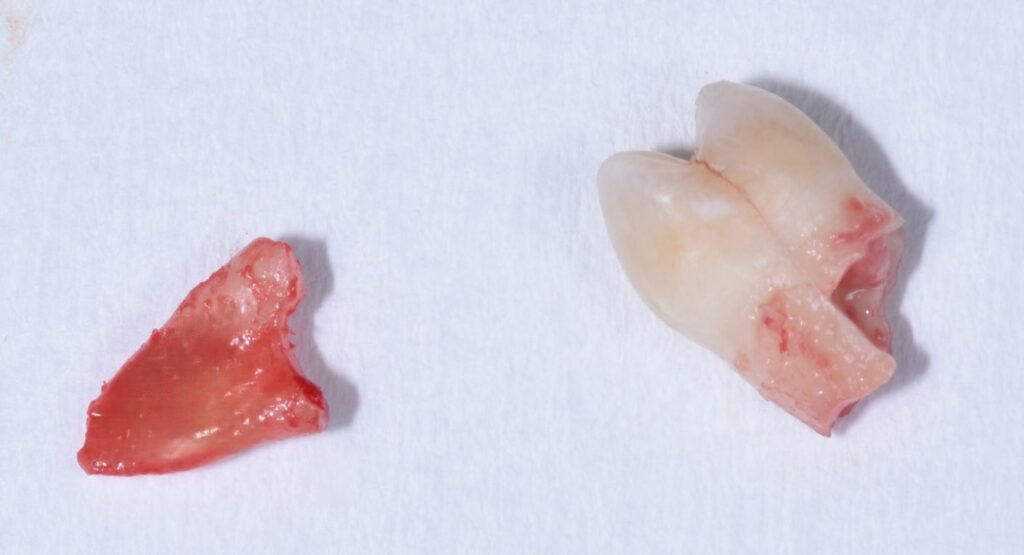
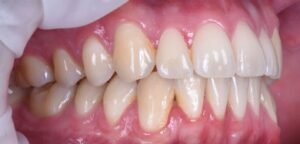
Due to the active inflammation and significant bone loss, the implant could not be placed immediately after extracting the damaged tooth. First, the inflammation needed to settle and the gums needed to heal. As a temporary, aesthetic solution, we placed the crown of his own tooth — after removing the root — between his other teeth. This way, the patient could function normally immediately during the healing period.
Step 2: Implant placement and bone augmentation
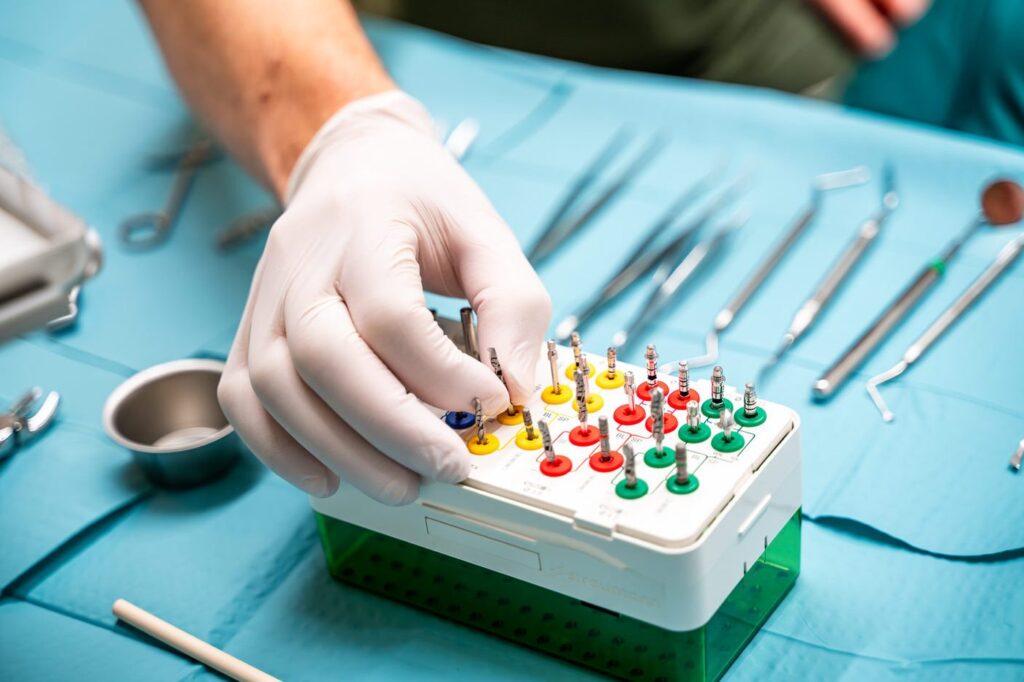
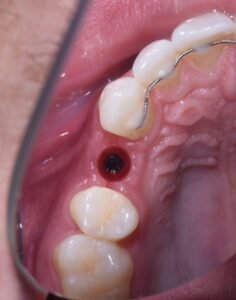
Once the oral mucosa had settled and oral health was restored, we could place the implant. At the same time, we performed bone augmentation: due to the inflammation, jawbone had been lost and a solid foundation is crucial for stability. We supplemented the missing bone so that the implant is well surrounded and has a solid base.
Step 3: Gum correction
For a natural and lasting aesthetic result, we strengthened the gum tissue around the implant. For this, we moved a small piece of gum tissue from another area of the mouth and attached it to the implant location. This supports both health and a natural appearance of the gums around the new tooth.
Step 4: Healing and integration (osseointegration)
After placement, a healing period of several months follows — in this case 4 months. During that time, the jawbone fuses with the implant; this process is called osseointegration. This gives the implant stability comparable to a natural root.
Step 5: Placement of the definitive crown
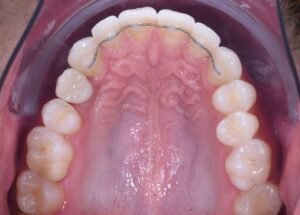
Once the implant is fully integrated and stable, the definitive crown is manufactured and placed. This crown is custom-made: we match the colour and shape to your natural teeth. The end result is a tooth that is virtually indistinguishable from your own teeth in terms of appearance and function.
The result: a restored smile and improved quality of life
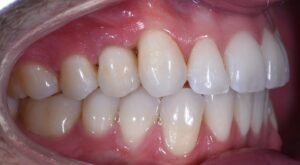
After completing the treatment and placing the definitive crown, our patient could immediately do everything he was used to again. The new tooth functions like a normal tooth — the pain and complaints disappeared and his confidence returned. An implant not only provides an aesthetic improvement but also noticeably contributes to your daily quality of life:
- Improved appearance: A complete, natural smile strengthens confidence and radiance.
- Improved speech: No more gap in the teeth that affects pronunciation.
- Improved comfort: A fixed, stable solution that feels like your own tooth, without irritation or shifting.
- Full functionality: Eating, laughing, and talking without limitations.
- Durability: An investment in your oral health with a solution that lasts for years.
With an implant, you replace a missing tooth in a durable way, without damaging other teeth in the process.
Frequently asked questions about dental implants
What is the lifespan of an implant?
With good oral hygiene and regular check-ups, an implant can last for decades, sometimes even a lifetime. The crown may need to be replaced over time, but the implant itself is preserved in many cases.
Is the treatment painful?
The procedure is performed under local anaesthesia, so you feel no pain during placement. After treatment, you may experience some pain or discomfort; this is usually manageable with painkillers. We ensure that you feel as comfortable as possible during and after the treatment.
Can everyone get an implant?
Most people are eligible for an implant, but sufficient jawbone and good general health are important. Smoking and certain medical conditions can reduce the chance of success. That is why we always conduct a thorough examination in advance to determine whether an implant is the right choice for you.
What are the advantages of an implant compared to a bridge?
The biggest advantage is that neighbouring teeth do not need to be ground down. An implant also stimulates the jawbone, which prevents bone loss — something that is more likely to occur with a bridge. Additionally, an implant often feels and functions more like a natural tooth, resulting in more comfort and a more natural feeling.
How long does the entire process take?
The duration varies per patient. In complex cases with bone augmentation, the process — from extraction to definitive crown — can take 6 to 9 months. With direct placement, this can be considerably shorter. During the intake consultation, you will receive a personal time estimate.